Friday, July 1, 2016

Day 19: Finding My Place

A view of the road outside my house.
       Yesterday, I rode into town in a cramped dala dala. The small minivan-sized bus with “Tracy Chapman” written on the front windshield and “Praise Jesus” on the back picked me up at the Fiber stop, just a five minute walk from my house and across the street from the large fiberboard factory. I squeezed into a seat in the third row. There were 20 people already in the dala dala, with more joining at each stop. I was lucky I had a seat. Last week I was standing on the lip outside the open sliding door with the motorcycles passing within inches of me. Pushed up against the window, I looked around. I was at least a head higher than anyone else around me, my white skin providing a stark contrast to dark color of everyone else’s. A little girl with a pink headband sitting next to me in her mom’s lap looked up at me with big eyes, only glancing away when her mother spoke. The conductor of the dala dala rattled the coins in his hand and I reached for me wallet. With the little girl’s mother squished up against me and solidly blocking access to my right pocket I squirmed and wiggled to fish out my wallet. I caught glances from others in the dala dala as I was finally able to hand the conductor my 400 shillings. “Clock Tower, Asante,” I said, using my limited Swahili. “Okay,” he responded in English.
A typical dala dala.
When I got off at Clock Tower, a man in a grey shirt came up to me. “You are looking for Airtel? Bank? Let me show you.” I said nothing and looked right, then left, and crossed the street. “Sir, how many days for safari?”, another man proclaimed as I walked by. “How many days?”, he repeated, following close behind me. I turned left down the street, pulled out my phone, and searched “Arusha post office”. I did my best to look like like I knew where I was going, even though it was obvious I was lost. I looked up and across the street to see “Tanzania Post Office” in big letters on the side a blue building. I put my phone back in my pocket, and pulled out my large, obvious camera for a few quick shots of the architecture and the busy round-about. Camera in hand, I once again crossed the street. “Sir, looking for post office? Here I can show you.” “Hey, brother from another mother, how are you? We know each other.” I kept my focus ahead and walked up the steps.
"Clock Tower" in Arusha.
Tourists are loud, ignorant of local customs, and unaware of their surroundings. They butcher the language, they stand in the middle of the sidewalk lost and look at their phones, they take pictures everything with their cameras. I am a tourist. I hate being a tourist. This would be the part where normally I would say that even after being here only for a little while, I don’t feel like a tourist anymore. But I’ve been in Arusha, Tanzania for almost three weeks now, and I’ve learned there is no chance I am ever going to blend in with the local population. But that’s okay. I am a tourist, I am the “other”. I will still do my best to learn the language, the customs, and my way around. But when I pass by a group of kids, I will always hear “Hi! Hi! How are you! Hi!”. When I can truly embrace my status as a tourist, I can find my place. Here, I will always be a mzungu.

Tuesday, May 24, 2016

busy times in Arusha...

Hey hey.

It’s been a crazy busy couple of weeks here at Twende. That combined with a plague of computer troubles means I have a lot of catching up to do. I’ll give the highlights in a few installments.

First, we’ve approximately doubled the daily number of people in the workshop. We have seven new interns from Arusha Technical College. They’ll be here working on a few different projects for about ten weeks. We’ve got some of them building a website, some working on mechanical projects, and some helping to expand our curriculum for secondary schools.

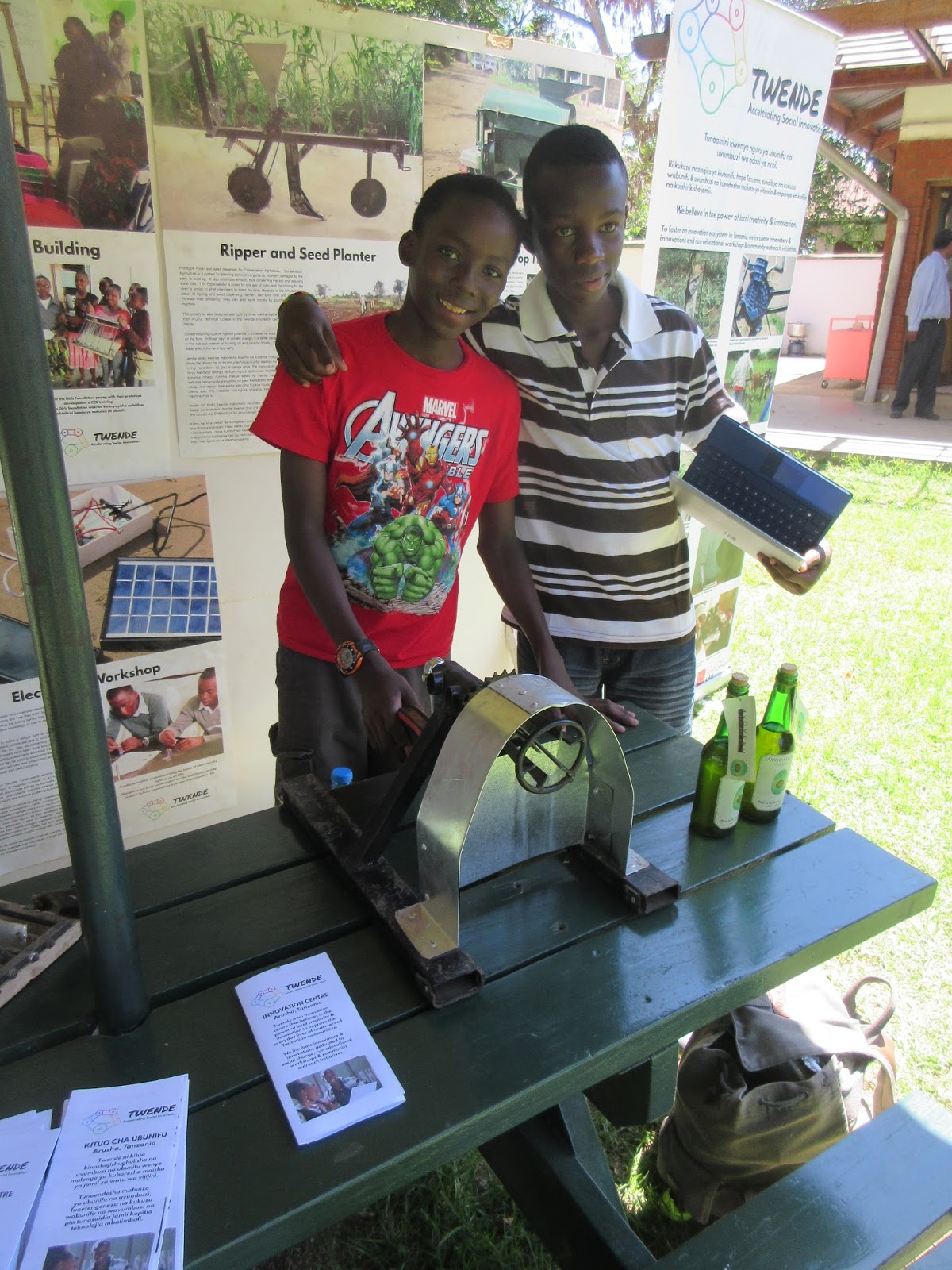
On top of the new interns, we’ve also got three Arusha Tech folks returning to continue developing an ox-pulled ripper-planter that they started last year. The ripper-planter (pictured below) is a substitute for a plough.  By disturbing the soil only just enough for planting, ripping maintains soil structure and fertility better than ploughing. This particular ripper is designed to plant seeds in the ripped soil as it goes. After building their first prototype here, the ripper-planter team won a grant to continue work on the machine. A lot of farmers I meet at trade fairs are interested in the machine, so I’m glad they found the time to continue—and it’s just nice to have some old friends back in the workshop. On top of that, it also suggests some interesting possibilities for attracting more students to Twende to build things.

Most technical colleges and universities here seem to have practical training programs that place students in various internships. I’m hatching some schemes to use that requirement to get students to Twende to either develop their own ideas or join an existing team here. My goal is that at least some of those students will invest enough care and effort into their projects that they’ll want to continue innovating here, like the ripper-planter team.

But I’m getting ahead of myself. I’ll try to post some updates on the different intern projects in a few weeks. Until then, I’m enjoying the flurry of activity and preparing for a few more interns who will be arriving in the next two months.


Monday, May 2, 2016

Let Girls Learn

[Arusha, Tanzania]

Good news, everyone!

Twende was invited to a USAID conference on girls' education. In about a week, I'll be representing Twende a "co-creation workshop" as part of the Let Girls Learn initiative (letgirlslearn.gov). Let Girls Learn was started last year by President and First Lady Barack and Michelle Obama. It's all about improving the perception of the value of girls, increasing their access to quality education, and equipping them to be powerful contributing members of society. The workshop I'm going to focuses on programs in Tanzania and Malawi.

This workshop is different from any event or grant I've been involved with before. It's not a conference so much as a big collaborative design challenge. USAID is bringing together representatives from around 75 organzations that deal with women's empowerment. They range from small local ones like Twende to foreign universities to large international organizations. On May 10th through the 12th, we're all meeting in Dar es Salaam, Tanzania's industrial capital, to design programs for adolescent girls in Tanzania and Malawi. We're going to start off by talking with students, experts in the field, and each other to explicitly define the big challenges and main obstructions to quality girls education in the two countries. Then, we'll brainstorm solutions and collectively design programs to address these problems. The goal is to come out of the workshop with several conceptual outlines of new programs. After that, we'll work with USAID to refine these concepts and turn them into formal proposals which we'll submit to USAID and other donors for funding.

Based on the bios of other participants, we seem to have a wide range of perspectives and specialties, so ideally we'll make some novel and productive combinations. I've never collaborated on anything of this scale--designing something with 74 other people sounds like quite a task--so I'm also curious to see how the whole workshop is facilitated. Designing a program with multiple other organizations sounds tricky, but exciting. I'm psyched to learn from the other participants who have so many years of experience in education and development around the world. Twende's focus on technology, especially mechanical technology, and support for grassroots innovation makes us somewhat unique among organizations in this space, so I think we'll have some valuable skills to contribute.

The next week's going to be busy, but I'll be sure to send an update after the workshop/

<3 Ad


Wednesday, April 20, 2016

Innovator Profile: Avomeru

Hi everybody! I thought it would be worthwhile to take a look at some of the projects Twende is incubating. So I looked up and picked the people sitting directly across the worktable from me, which means that today I'm going to tell you a little about Avomeru, an avocado oil business currently based out of Twende.

The guys in the picture are my friends and co-workers, Igg, Jesse, and Tristan. Jesse has been working on making oil out of waste avocados from his home village, Leguruki, since 2014. That was the year when there was an International Development Design Summit (IDDS) in Arusha. If you're not familiar with IDDS, you can read about it at www.idin.org/idds. Basically, it's a summit that brings together entrepreneurs, makers, and all kinds of innovators from around the world to work with local communities on solving local problems. 

Jesse's team, working in Leguruki, saw hundreds of huge, delicious Reed avocados left on the ground wherever they fell, getting eaten by animals or just rotting. It turns out that Reed avocados grow wild and abundantly in Leguruki, but are too fragile and short-lived to ship to market. So over the course of the summit, they developed a plan for drying and pressing the avocados to extract oil. Now, community team members in Leguruki can press their formerly discarded avocados into cooking oil.

Over the last year, people around the world, including a team of MIT students and more partners in Leguruki, have joined the project. Jesse, Tristan, and Igg started turning the venture into an independent company under the name Avomeru. They've been perfecting the production process, conducting market research, and drumming up interest in pure, Tanzanian-made avocado oil for cooking and cosmetics. They've discovered a big demand for their oil, and Jesse and Igg are now working full time one getting funding to scale up from prototype to production. Once they get everything up and running, the plan is for Avomeru to provide oil presses to avocado-growing coops through interest-free loans, buy the oil, process and package it, then sell it to high-end food and cosmetic markets. 

To hear the story directly from them and see some images of Leguruki, check out their promotional video: https://vimeo.com/159756188

Monday, April 11, 2016

Internships in Tanzania

Hey everybody!

From what I can remember, now is the time when a lot of folks are figuring out summer internships. So I'd like to take this opportunity to advertise a few unpaid internships here at Twende in Tanzania.

That's how I originally got involved with Twende, and I highly recommend it to any BOW students looking for development work. This summer, we're assembling several teams of Tanzanian and international interns combined to work on open-ended projects that will make lasting contributions to Twende. The work environment here is super collaborative, and we work hard to place everyone in a position that aligns strongly with their skills and interests. Expect to get a lot of independence and a lot of responsibility from day one. Expect to use design thinking and get to know the people you're designing for. Come here with an open mind and a lot of energy, and expect to learn. Check out the Twende internships here:

Wednesday, March 30, 2016

Microscoops

Hey hey hey.

The other day was basically Christmas at Twende workshop here in Arusha. We got MICROSCOPES!


(https://www.mccrone.com/mm/wp-content/uploads/2015/03/foldscope.jpg)


They’re samples of the Foldscope, an invention from PrakashLab at Stanford, a team that’s democratizing science by making microscopes affordable to scientists, students, and curious people around the world. A whole Foldscope costs about a dollar, fits in a pocket, and stands up to being dropped, thrown or stepped on because it’s made out of cardstock. The microscopes also came with little magnets for attaching them to phone cameras to take pictures. So, here are some of the first pictures we took:


 From left to right: a dead butterfly I found on my walk to work, the end of that butterfly's foot, the edge of that butterfly's wing.


These pictures were taken with the Foldscope’s low magnification lens. Next, I want to try out the higher magnification lens to see what I can find in different sources of drinking water around here. Hopefully we can integrate these microscopes into some of our school workshops. Let me know in the comments if you think of any cool tiny things to look at or any good uses for a pocket microscope. For more information, check out the Foldscope website and the online community of Foldscop-ists.

Monday, March 7, 2016

Creative Capacity Building

Hi everybody.

I was up to my eyeballs in grant applications last week, so instead of blogging about that, why don’t I describe what we’d do with some that money...

Twende runs trainings for all kinds of people around the Arusha region of Tanzania. Sometimes we invite people into the workshop, and sometimes we take the workshop to them. Our central training is "Creative Capacity Building (CCB)", a method developed at MIT D-Lab and taught at IDIN workshops and summits around the world (d-lab.mit.edu/creative-capacity-building). The specifics of the training get adapted for the location and participants, but the fundamental idea is the same: teaching people the skills they need to design and build technologies that fill unmet needs in their own lives. Over the course of the program, participants learn to use tools, identify challenges in their lives that can be met with technologies, then design and build technologies to meet those challenges.

Here are some examples of innovations that came out of past CCBs:

A group of farmers made this beehive out of materials that are cheap and easy to find in their village.


A woman who makes and sells a bunch of different handcrafts designed this punch to make leather keychains.


 Students from a girls' education organization prototyped a vegetable cutter to cut down on time they spend cooking.


 Students from a local school made a hand-crank maize sheller.

.

I’m working on adapting CCB training and other Twende curricula to be relevant and useful to specific audiences like small business owners or secondary school girls. Hopefully in a few months, we'll have grant funding for more programs.